On this page
- Who is this example for?
- A US resume is not a translated CV
- Resume or CV?
- US vs. UK conventions at a glance
- A note on page size
- US resume tips, section by section
- Sample bullet points for a US resume
- Common mistakes
- Summary examples
- Strong action verbs
- Little US experience? What to include
- Already have a resume in another language?
- Build your US resume
- Frequently asked questions
Turn this example into your own resume
Build your resume from this exampleWho is this example for?
This example is for anyone applying to a US employer who isn't sure about American resume conventions: international professionals, people relocating to the US, and candidates whose previous resume was written for another country. The fictional candidate is an IT project manager with five years of experience.
When you open this example in Cvbuildly, the resume language is set to English, so section headings (Work Experience, Education, Skills…) appear in English. You can set the resume language for any resume in the builder settings.
A US resume is not a translated CV
Running your existing resume through a translation tool usually produces stiff, inaccurate text. When preparing a resume for US employers, keep these differences in mind:
- No photo: US resumes don't include one; employers generally expect resumes without photos to help avoid bias.
- No personal details: leave off your date of birth, age, marital status, nationality, religion and ID numbers.
- Verbs, not sentences about yourself: bullets start with a past-tense action verb and no subject: "Led…", "Reduced…", "Launched…". For your current job, present tense is common: "Manage…".
- Job titles: use the closest common US equivalent rather than a literal translation of your title, and keep the original in parentheses if it helps.
- Dates: a format with month names, such as "Mar 2022 – Present", avoids confusion; numeric dates like 03/04/2022 are read differently in the US and in Europe.
- Education: use US degree names, such as "Bachelor of Science" or "Master's degree". If your grades used a different scale, state the scale or leave the GPA off; a credential evaluation service can give you a US equivalent if an employer asks.
Resume or CV?
In the US and Canada, the one-to-two-page document for job applications is a resume; a CV usually means a longer academic document with publications, presentations and research. In the UK, Ireland and most of Europe, the job application document is also called a CV. In short: if a posting asks for a "resume", it expects the US style. The overall structure is largely the same.
US vs. UK conventions at a glance
| Topic | US (resume) | UK (CV) |
|---|---|---|
| Length | Usually one page, two for experienced candidates | Usually two pages |
| Summary heading | Summary | Personal Profile / Profile |
| Spelling | organize, color, center | organise, colour, centre |
| References | Usually left off | "References available upon request" is common |
Whichever spelling you choose, use it consistently throughout your resume. For US jobs, use American spelling.
A note on page size
US offices print on Letter-size paper, while Cvbuildly exports PDFs in A4. Most US employers read resumes on screen or through an applicant tracking system, which reads the text rather than the page size, so this rarely matters. If you plan to print your resume on Letter paper, check the print preview and use "fit to page" if needed.
US resume tips, section by section
Contact information
Name, phone number with country code if you're outside the US, email, city and state (or city and country), and a LinkedIn link. If you're already authorized to work in the US, a short line such as "Authorized to work in the US" can answer a question recruiters often have about international applicants. Only state what's accurate for you.
Summary
In three or four sentences, cover your years of experience, your area of expertise and your strongest achievements. Avoid first-person, generic lines like "I am a hardworking person"; write short, information-dense sentences instead.
Work experience
Write three to five bullets per job, each starting with a strong verb and ending with a measurable result where possible. If a former employer isn't known in the US, add a short description next to its name, for example "regional logistics company with three warehouses".
Skills and languages
List technical skills and tools using the English terms from the posting. For languages, CEFR levels (B2, C1) are widely understood by international employers; plain-language levels such as fluent or conversational are also common in the US. Your first language is listed as "Native" (in the builder, choose the native-speaker level).
Sample bullet points for a US resume
- Led a cross-functional team of 8 to deliver a warehouse management system rollout across 3 sites on schedule.
- Reduced project reporting time by introducing automated dashboards in Jira and Power BI.
- Coordinated with suppliers in Germany and the Netherlands to align delivery schedules.
- Introduced a risk register that became the standard for all IT projects in the department.
- Mentored 2 junior project coordinators through their first year.
- Presented monthly project status updates to senior leadership.
Common mistakes
- Using machine-translated text without editing it.
- Writing long sentences that start with "I" or "my".
- Mixing British and American spelling.
- Leaving country-specific abbreviations, exams or certifications unexplained.
- Adding a photo, date of birth or marital status out of habit.
Summary examples
Graduate: "Recent business administration graduate with two internships in finance and marketing. Confident with Excel and Power BI, and eager to grow on a corporate finance team."
Mid-level: "Software engineer with 4 years of experience building e-commerce back-end services in Node.js and PostgreSQL. Focused on performance, testing and thoughtful code reviews."
Senior: "Operations manager with more than ten years in logistics, leading teams of up to 40 people across multiple warehouses. Known for process improvement and clear stakeholder communication."
Strong action verbs
| What you're describing | Verbs to use |
|---|---|
| Leadership | Led, Managed, Coordinated, Mentored |
| Improvement | Improved, Reduced, Streamlined, Optimized |
| Building something new | Launched, Built, Designed, Introduced |
| Analysis | Analyzed, Assessed, Identified, Forecasted |
| Communication | Presented, Negotiated, Trained, Partnered |
Try not to repeat the same verb in consecutive bullets, and rewrite bullets that start with "Responsible for…" using action verbs.
Little US experience? What to include
If you're a student, recent graduate or new to the US job market, use these sections to support your experience:
- Relevant Coursework: four to six courses related to the job.
- Projects: class or personal projects, the tools used and the outcome.
- Volunteer Experience: volunteer work and community roles.
- International experience: exchange programs and work with international teams are valued by many employers.
Already have a resume in another language?
Cvbuildly's AI translation can create an English copy of your existing resume; your original stays untouched. Always review the translation, adjust job titles to US equivalents and check dates and degrees before you apply.
Build your US resume
Open this example in the resume builder; the resume language comes set to English. While writing, the magic wand helps turn your sentences into professional phrasing. For the fundamentals, read how to write a resume; for an accompanying letter, see our cover letter examples; and for the systems US employers use to screen applications, see the ATS resume guide.
Frequently asked questions
Should I include a photo on a US resume?
No. US and Canadian employers generally expect resumes without photos. Some other countries have different customs, so check local expectations when you apply elsewhere.
What's the difference between a CV and a resume?
In the US and Canada, a resume is the short document for job applications and a CV is a longer academic record. In the UK and Europe, the job application document is also called a CV.
Can I machine-translate my resume into English?
You can use a translation as a first draft, but always edit the result. Check job title equivalents, verb usage and date formats, or the text may read as unnatural.
How do I list foreign degrees on a US resume?
Use the closest US degree name, keep the school's name and location, and state the grading scale if it isn't 4.0. If an employer needs a formal equivalent, a credential evaluation service can provide one.
Is the PDF Letter size?
Cvbuildly exports A4 PDFs. Employers and applicant tracking systems read the text on screen, so this rarely matters; if you print on Letter paper, check the print preview and use "fit to page" if needed.
Turn this example into your own resume
The example opens in the editor as a new resume; your existing resumes stay untouched. Replace the details with your own and download your PDF.
Build your resume from this exampleFree · No sign-up required
More resume examples
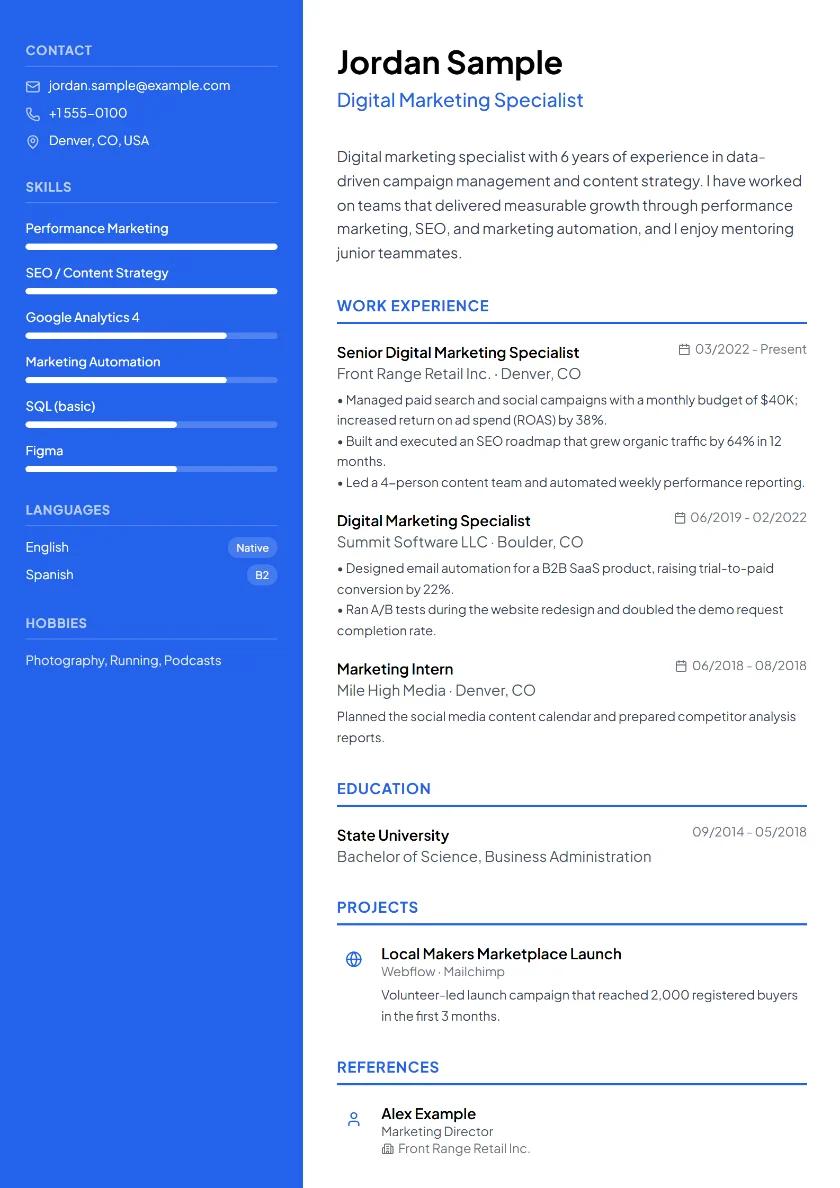
Ready-to-Use Resume Example
Open a ready-made resume example, replace the details with your own and download a watermark-free PDF in minutes. No sign-up required.
View example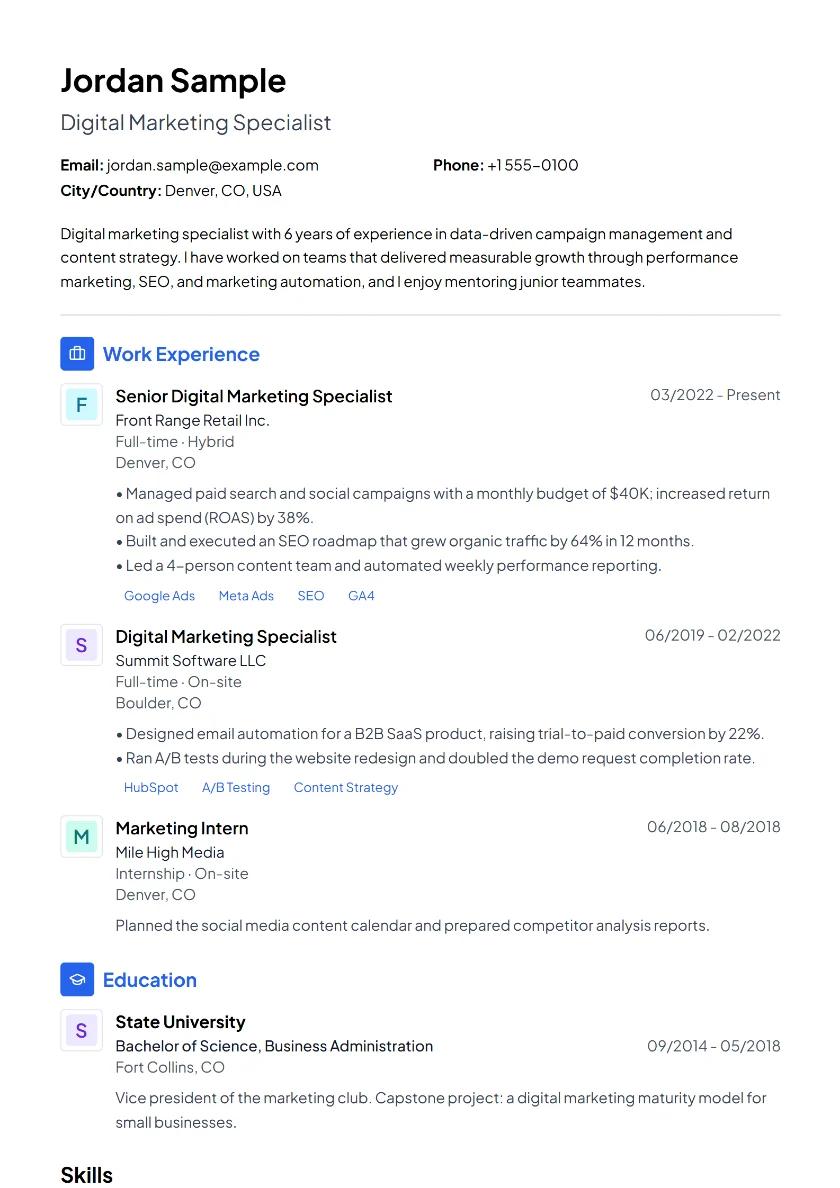
Blank Resume Template
Start from a blank resume template with the sections already in place, fill it in online without fighting the layout, and download it as a PDF, Word or TXT file.
View example
Software Engineer Resume Example
A software engineer resume example that highlights your tech stack, projects and measurable engineering impact, plus section-by-section writing tips.
View exampleAccountant Resume Example
An accountant resume example that highlights the processes you own, the software you use and the improvements you've made, from bookkeeping to the general ledger.
View example